(Tianjin, September 18, 2026) On the morning of September 18, the 2026 China Green Convention & Exhibition Conference at the National Convention and Exhibition Center (Tianjin) entered its third day of proceedings. The morning's program centered on the two major themes of "standards driving green conventions and exhibitions" and "digital-intelligent empowerment renewing exhibitions." Practitioners from national standards-setting bodies, leading universities, exhibition-technology companies, and industry frontlines gathered to explore, from the perspectives of standards implementation, technological innovation, and model transformation, the pathways and future trends of green conventions and exhibitions.
Tang Guifa, Vice Chair of the National Technical Committee for Standardization of the Convention and Exhibition Industry, first delivered a speech titled "National Standards Drive the Green Transformation and High-Quality Development of Conventions and Exhibitions." He pointed out that although China's exhibition industry has developed steadily in recent years, long-standing problems—high resource consumption, an extensive operating model, and an incomplete green management system—have become bottlenecks constraining the industry's refined and sustainable development, and that standards development is the key to breaking through.
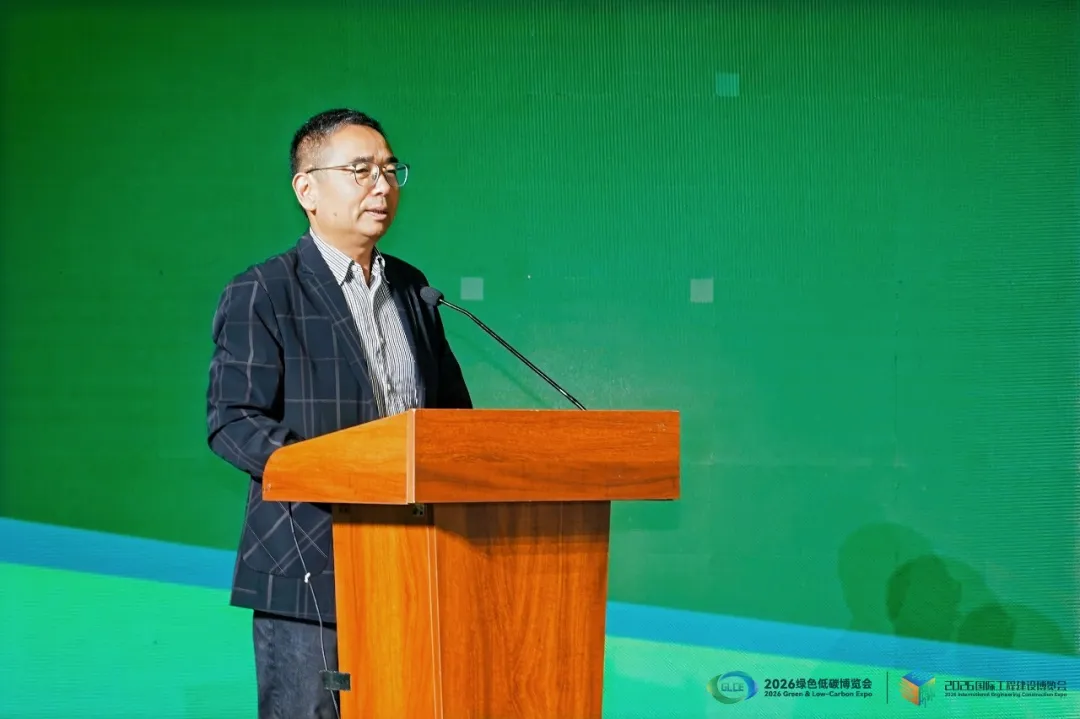
He strongly called on the entire industry to proactively study and fully implement the standards, noting that green transformation is a major trend and that "the earlier the change, the better"—though it requires greater investment initially, it is the only path in the long run. He stressed that the vitality of standards lies in implementation and their value in empowerment, and that the industry is in a critical period of transition from "holding exhibitions" to "holding green and safe exhibitions well."
Wu Zhenzhen, Senior Manager of the Assessment Section of the General Management Department of the China Foreign Trade Centre, systematically presented three national standards—the Guidelines for the Evaluation of Green Stands, the Guidelines for Green Exhibition Operations, and the Basic Requirements for Safety Management of Exhibition Venues—vividly summarizing them as the "weights and measures," the "roadmap," and the "safety lock."
The Guidelines for the Evaluation of Green Stands specify four major categories of indicators—recyclability, reduction, environmental friendliness, and functional fulfillment—and set out core quantified hard targets: a 100% recovery rate for main structural materials, a no-less-than-70% utilization rate of equipment, a no-less-than-80% utilization rate of energy-saving lighting, and a solid-waste generation rate no higher than 15%.
The Guidelines for Green Exhibition Operations establish the principles of environmental protection (the three R's), foresight, and coordination, defining the four parties—organizers/contractors, exhibitors, venue operators, and service providers—and a coordination matrix across the five stages of preparation, setup, exhibition, dismantling, and review. The Basic Requirements for Safety Management of Exhibition Venues build a safety management system across four major blocks—systems and responsibilities, personnel and facilities, environment and sanitation, and operational control and emergency response—in 19 areas. Wu Zhenzhen noted that all three standards have been forged from practice and that the China Foreign Trade Centre will continue to rely on the Canton Fair platform to promote their implementation.
Professor Luo Qiuju of the School of Tourism Management, Sun Yat-sen University, spoke on "Trends in the Green Development of the Convention and Exhibition Industry and Prospects for the Future Landscape." Drawing on the difficult journey of the Canton Fair's green development, she pointed out that green and low-carbon exhibition management has changed from a "multiple-choice question" into a "compulsory question."
She identified four major trends the international exhibition industry is undergoing: first, a common language, as international standards move from fragmentation toward systematization, such as the new version of ISO 20121 and the EIC's eight assessment systems; second, demonstration on the ground, as leading institutions commit to high shares of green electricity, circular waste, and green transport, with ESG performance becoming a new corporate competitiveness; third, modularization, as the efficiency and value-for-money advantages of modular building significantly address exhibitors' two key pain points of "cost" and "efficiency," making it the core of the carbon-reduction model; and fourth, AI reshaping, as AI technology makes green building faster, more precise, and more personalized, effectively solving the problem of green stands being "not personalized enough" through decomposed design.
In the corporate-practice segment, Chen Yi, Vice President of Omateng Exhibition Technology (Shanghai) Co., Ltd., shared the application of AI technology in green stand design. He argued that AI is the key to resolving the impossible triangle of "fast, good, and green" in stand design; through scenarios such as co-creation with clients, precise capture of reference images, rapid conversion of sketches into renderings, and fine-tuning of proposals, AI compresses the design delivery cycle from days to minutes.
Chen Yi emphasized that the essence of AI is "digital carbon reduction"—doing more testing in the data world means making fewer mistakes in the physical world. He also noted three major limitations of AI: distorted sense of scale, homogenization of original work, and an inability to understand a brand's soul. AI will not replace designers, but designers who make good use of AI will have the advantage.
He Guanghui, Founder of Yida Environmental Protection Technology (Shanghai) Co., Ltd., shared the development trends and practical application of modular green building. He argued that modular green building should be promoted through "interest-driven" rather than "concept-driven." Addressing the exhibition-building industry's pain points of "no product standards, no industry standards, and no pricing standards," Yida's modular products offer structural safety, 100% environmental friendliness, B1-level flame retardancy, costs over 30% lower than traditional building of equivalent form, and rapid delivery of a 36-square-meter booth within three hours.
Zhou Jinglong, CEO and Founder of Daotong Co-Creation Technology and a member of the National Convention and Exhibition Standardization Committee, spoke on "In the AI Era, How Will Green Conventions and Exhibitions Change?" He offered a counterintuitive judgment: the more prevalent AI-generated content becomes, the scarcer and more valuable authentic, in-person, face-to-face interaction will be.
He pointed to three systemic "scene wastes" in the industry—organizers waste content, venue operators waste foot traffic, and service providers waste scenes—all of which represent enormous data assets. Zhou shared a three-step approach to AI implementation: first, make good use of Q&A-type AI; second, let AI change the organization (forming one-person companies plus co-creation teams); and third, make products AI-enabled. He also shared the practical experience of the "New Exhibition Co-Creation Park" mini-program in co-creative investment promotion and model replication.
Li Bowen, CEO of Xuexing Cultural Communication Co., Ltd. and Deputy Director of the New Media Marketing Committee of the China Convention and Exhibition Society, spoke on "From Marketing to Revenue—Digital-Intelligent Empowerment of the Exhibition Industry's Second Growth Curve," providing an in-depth analysis of the industry's growth dilemma and the path to breaking through.
He noted that the exhibition industry has bid farewell to its golden age and entered a silver age requiring careful cultivation; weak growth stems from the fact that price, place, and promotion in the 4P framework have been pushed to the limit, while "Product"—the intangible service value of exhibitions—has not been fully explored. Li Bowen proposed three major growth directions: the market-oriented transformation of government exhibitions, the rejuvenation of long-established exhibitions, and the AI transformation of traditional business. The matching logic of B2B exhibitions should be "people matching people" rather than "products matching people"; through AI-generated content, precision marketing, and appointment-booking platforms, exhibition outcomes can be transformed from "unknown" to "certain."
Lu Cheng, Deputy Director and Secretary-General of ICEEC, hosted the morning program on September 18. The 2026 China Green Convention & Exhibition Conference, held over two and a half days, thus concluded successfully.
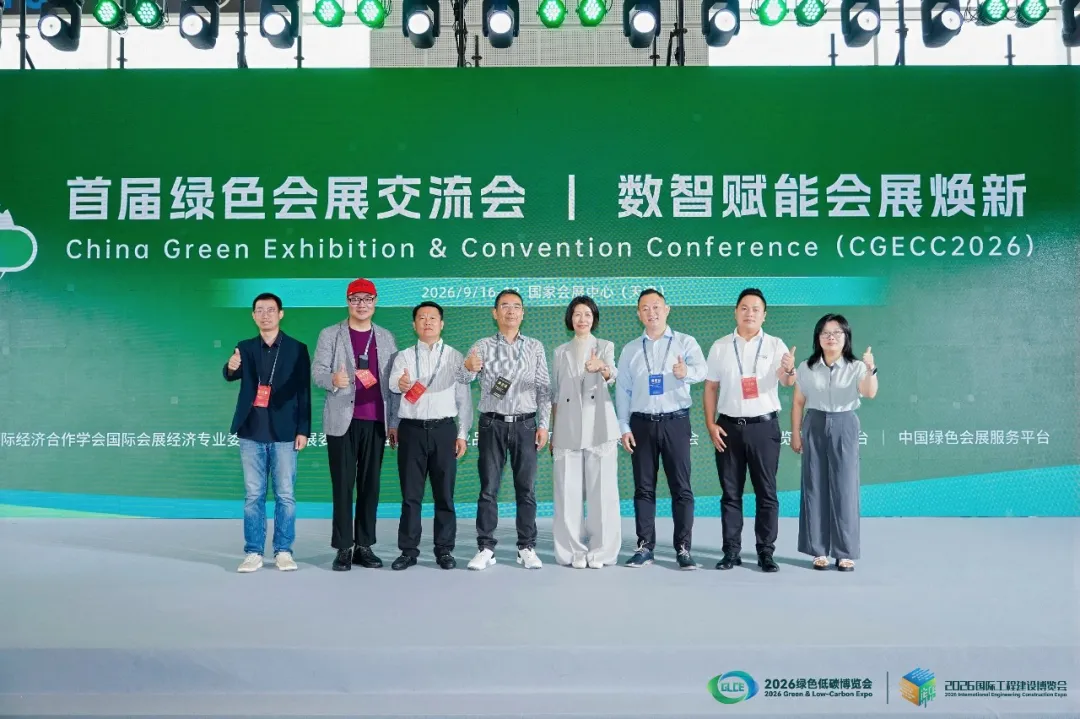
From the macro policies and industry consensus of the main forum, through the dedicated sessions on green display and industry-education integration, to the in-depth dialogues on standards development and digital-intelligent empowerment, the conference comprehensively presented the frontier exploration and practical pathways of the Chinese exhibition industry's green transformation. With the implementation and promotion of three national standards, the launch of the Green Convention & Exhibition Service Platform, and the accelerating application of new technologies such as AI and modularization, China's exhibition industry is steadily moving toward a new stage of coordinated development in standardization, greening, and digitalization.